

How DOOH Is Revolutionising Mining Sites: Dynamic Engagement in Harsh Conditions
Introduction
At first glance, mining might not be the first industry that comes to mind when you think about advertising or digital engagement. Yet the strategic use of Digital Out-of-Home displays in mining environments is rapidly gaining traction, not for consumer advertising, but for operational safety, workforce communication, and stakeholder engagement in some of the toughest conditions in Australia.
Digital Out-of-Home, commonly known as DOOH, has been one of the fastest-growing media channels in recent years. It has evolved far beyond traditional roadside billboards and commuter screens. Today, DOOH includes dynamic, data-responsive displays that can update in real time based on environmental conditions, operational inputs, and audience behaviours. For mining operations, where safety, clarity of communication, and contextual awareness are critical, this evolution is transformational.
In this blog, we explore why DOOH is uniquely suited to mining environments, the trends driving adoption in the sector, and how purpose-built solutions from Adverto support safer and more connected mine sites.
The Evolution of DOOH From Advertising to Operational Infrastructure
DOOH has evolved rapidly over the past decade. What began as static digital signage has become a network of intelligent communication platforms capable of responding to real-world data such as time of day, weather conditions, site activity, and workforce movement.
This shift reflects a broader digital transformation across physical environments, where relevance and immediacy are essential. In mining, where operations are complex and conditions can change quickly, the ability to update messaging instantly is invaluable.
For example, instead of relying on printed notices or manual briefings, mining operators can now deliver real-time updates across multiple locations on site. Safety alerts, shift updates, weather warnings, and operational notices can all be distributed from a central platform in seconds.
Mining Challenges That DOOH Helps Solve
Operating in Harsh Conditions
Mining sites are defined by extreme environments. Heat, dust, vibration, humidity, and exposure to the elements place enormous strain on equipment. Traditional signage often fades, becomes unreadable, or fails entirely under these conditions.
DOOH hardware designed specifically for outdoor and industrial environments offers a different level of resilience. High-brightness displays ensure visibility even under direct sunlight, while rugged enclosures protect internal components from dust, moisture, and temperature fluctuations.
This reliability ensures that critical information remains visible at all times, supporting safe decision-making in environments where clarity can prevent incidents.
Centralised Communication Across Large Sites
Many mining operations span vast areas with multiple access points, work zones, and communal areas. Communicating consistently across such sites is challenging when relying on static signage or word-of-mouth updates.
DOOH enables centralised content control across an entire site or network of sites. Operators can schedule content, deploy updates instantly, and ensure every screen displays the right message at the right time.
This capability is particularly valuable during shift changes, emergency situations, or operational updates where timing and consistency are critical.
Contextual Safety Messaging
Safety is at the core of mining operations. Modern DOOH platforms can integrate with data sources such as weather systems, environmental sensors, or operational schedules to deliver context-aware messaging.
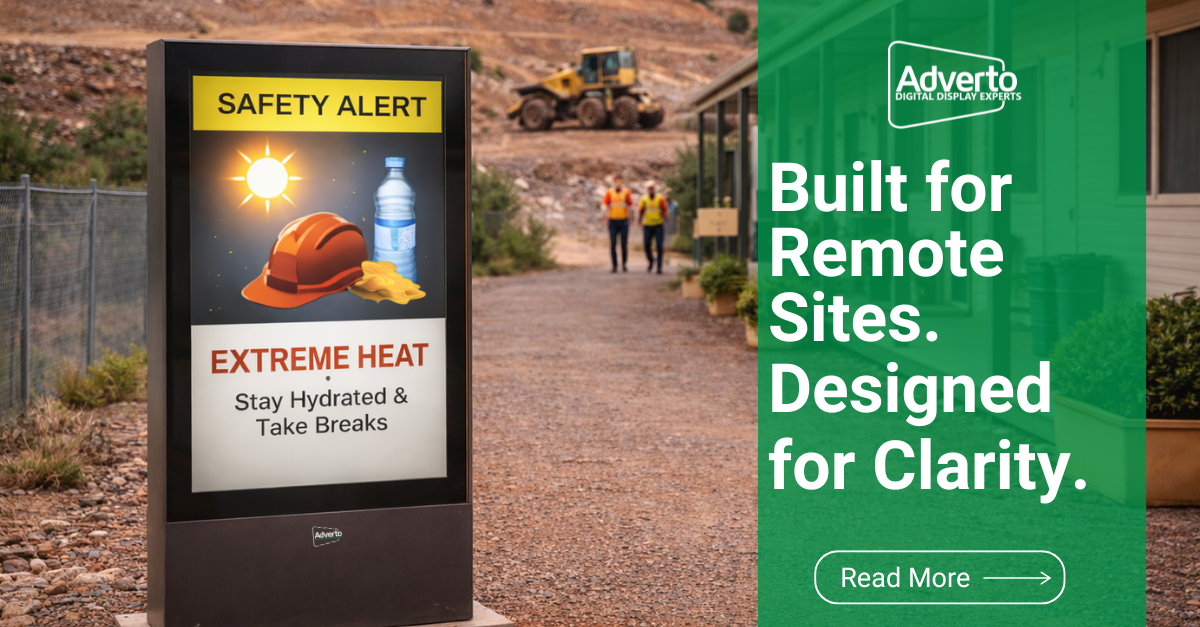
For example, screens can display heat stress reminders during high-temperature periods, promote dust mitigation protocols when air quality drops, or reinforce fatigue management messaging during extended shifts.
These dynamic alerts help reinforce safety culture by delivering relevant information exactly when it is needed, rather than relying on static messages that may be overlooked.
Supporting Productivity and Workforce Engagement
Beyond safety, DOOH plays a growing role in operational efficiency and workforce engagement.
Screens positioned in break areas, transit points, and vehicle bays can display production updates, site performance metrics, training reminders, and recognition messages. This real-time visibility helps keep teams aligned with operational goals and reinforces transparency across the organisation.
For visiting contractors and stakeholders, DOOH provides a consistent platform for induction content, site maps, procedural guidance, and emergency instructions. This reduces the need for repeated briefings and ensures everyone on site receives the same information.
Trends Driving DOOH Adoption in Mining
Several broader DOOH trends are accelerating adoption within industrial environments.
Dynamic and data-driven content is becoming standard, allowing messaging to adapt based on real-world conditions. Centralised content management platforms enable remote control across large networks. Analytics and reporting tools provide insights into content performance and engagement.
These capabilities, once associated primarily with advertising, are now being applied to operational communication in sectors like mining, construction, and energy.
The Future of DOOH in Mining
As mining operations continue to prioritise safety, efficiency, and digital transformation, DOOH is becoming an essential part of site infrastructure.
With rugged hardware, high-visibility displays, and real-time content control, DOOH supports clearer communication in environments where it matters most. It bridges the gap between digital intelligence and physical operations.
For mining organisations looking to modernise site communication and enhance workforce awareness, DOOH delivers lasting value beyond traditional signage.